
-
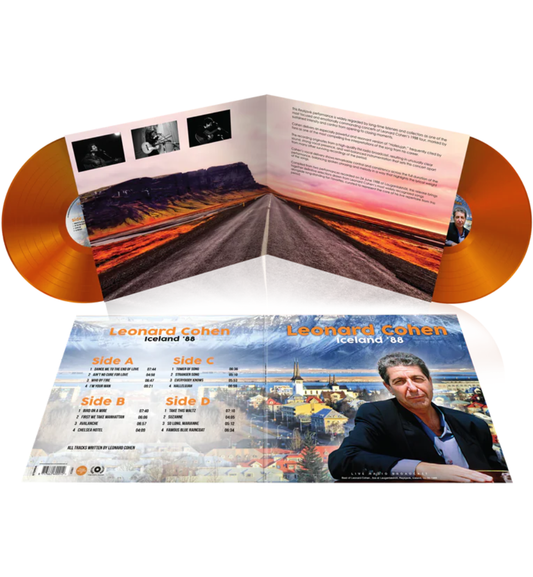
Leonard Cohen – Iceland ’88 (Limited Edition Double Album on 180g Transparent Orange Vinyl)
Regular price £39.99 GBPRegular priceUnit price per
LEONARD COHEN History

Leonard Cohen was born on 21 September 1934 in Montreal, Quebec, Canada. Renowned for his unmistakable baritone voice, poetic lyrics and deeply philosophical songwriting, Cohen built a career spanning more than five decades, influencing artists across folk, rock, alternative and contemporary music.
Before becoming a musician, Cohen established himself as a respected poet and novelist. His literary career began in 1956 with the poetry collection Let Us Compare Mythologies. His novels included The Favourite Game (1963) and Beautiful Losers (1966). However, inspired by the success of the American folk movement, Cohen turned his attention to songwriting in the mid-1960s.
Songs of Leonard Cohen was released in 1967, bringing Suzanne, So Long, Marianne and Sisters of Mercy to his debut album. Its restrained arrangements foreground the voice, guitar and lyrics.
Songs from a Room followed in 1969, before the 1970s albums Songs of Love and Hate, New Skin for the Old Ceremony and Recent Songs. Love, religion, politics and mortality recur across their lyrics, with changes in instrumentation giving each record its own setting.
Hallelujah first appeared on Various Positions in 1984. Later interpretations by John Cale, Jeff Buckley and other singers brought different arrangements and selections of verses to the song, extending its life beyond Cohen’s original recording.
Cohen revised Hallelujah over a long period, developing more verses than appear in any single familiar version. Comparing his own performances with later interpretations reveals how the chosen verses change the song’s emphasis.
During the 1980s and 1990s, Cohen increasingly used synthesisers and contemporary production. Various Positions includes Dance Me to the End of Love; I’m Your Man and The Future followed with songs such as First We Take Manhattan, Everybody Knows and Closing Time.
In the 1990s, Cohen spent several years at the Mount Baldy Zen Center in California, studying with Kyozan Joshu Sasaki and becoming ordained as a Zen monk. His writing continued to engage with Jewish traditions alongside his other spiritual interests.
Another remarkable chapter of Cohen’s career began in 2008 when he returned to touring after discovering that his longtime manager had stolen millions of dollars from his retirement savings. Those concerts revisited songs from across his career in arrangements made with a new touring band.
Cohen died on 7 November 2016, aged 82, shortly after You Want It Darker, the final studio album released during his lifetime. A further album, Thanks for the Dance, appeared posthumously in 2019.
Cohen’s lyrics connect his recording career with his earlier work as a poet. He was inducted into both the Canadian Music Hall of Fame and the Rock and Roll Hall of Fame, while his influence can be heard in artists ranging from Nick Cave and Bob Dylan to U2, R.E.M. and countless modern singer-songwriters.
Songs of Leonard Cohen and Songs of Love and Hate introduce the earlier acoustic settings, while I’m Your Man and The Future use more electronic arrangements. Live releases can contain changed lyrics or different song structures, particularly for Hallelujah. Check performance dates and track lists when comparing concert records with studio compilations.
Before becoming a musician, Cohen established himself as a respected poet and novelist. His literary career began in 1956 with the poetry collection Let Us Compare Mythologies. His novels included The Favourite Game (1963) and Beautiful Losers (1966). However, inspired by the success of the American folk movement, Cohen turned his attention to songwriting in the mid-1960s.
Songs of Leonard Cohen was released in 1967, bringing Suzanne, So Long, Marianne and Sisters of Mercy to his debut album. Its restrained arrangements foreground the voice, guitar and lyrics.
Songs from a Room followed in 1969, before the 1970s albums Songs of Love and Hate, New Skin for the Old Ceremony and Recent Songs. Love, religion, politics and mortality recur across their lyrics, with changes in instrumentation giving each record its own setting.
Hallelujah first appeared on Various Positions in 1984. Later interpretations by John Cale, Jeff Buckley and other singers brought different arrangements and selections of verses to the song, extending its life beyond Cohen’s original recording.
Cohen revised Hallelujah over a long period, developing more verses than appear in any single familiar version. Comparing his own performances with later interpretations reveals how the chosen verses change the song’s emphasis.
During the 1980s and 1990s, Cohen increasingly used synthesisers and contemporary production. Various Positions includes Dance Me to the End of Love; I’m Your Man and The Future followed with songs such as First We Take Manhattan, Everybody Knows and Closing Time.
In the 1990s, Cohen spent several years at the Mount Baldy Zen Center in California, studying with Kyozan Joshu Sasaki and becoming ordained as a Zen monk. His writing continued to engage with Jewish traditions alongside his other spiritual interests.
Another remarkable chapter of Cohen’s career began in 2008 when he returned to touring after discovering that his longtime manager had stolen millions of dollars from his retirement savings. Those concerts revisited songs from across his career in arrangements made with a new touring band.
Cohen died on 7 November 2016, aged 82, shortly after You Want It Darker, the final studio album released during his lifetime. A further album, Thanks for the Dance, appeared posthumously in 2019.
Cohen’s lyrics connect his recording career with his earlier work as a poet. He was inducted into both the Canadian Music Hall of Fame and the Rock and Roll Hall of Fame, while his influence can be heard in artists ranging from Nick Cave and Bob Dylan to U2, R.E.M. and countless modern singer-songwriters.
Songs of Leonard Cohen and Songs of Love and Hate introduce the earlier acoustic settings, while I’m Your Man and The Future use more electronic arrangements. Live releases can contain changed lyrics or different song structures, particularly for Hallelujah. Check performance dates and track lists when comparing concert records with studio compilations.


